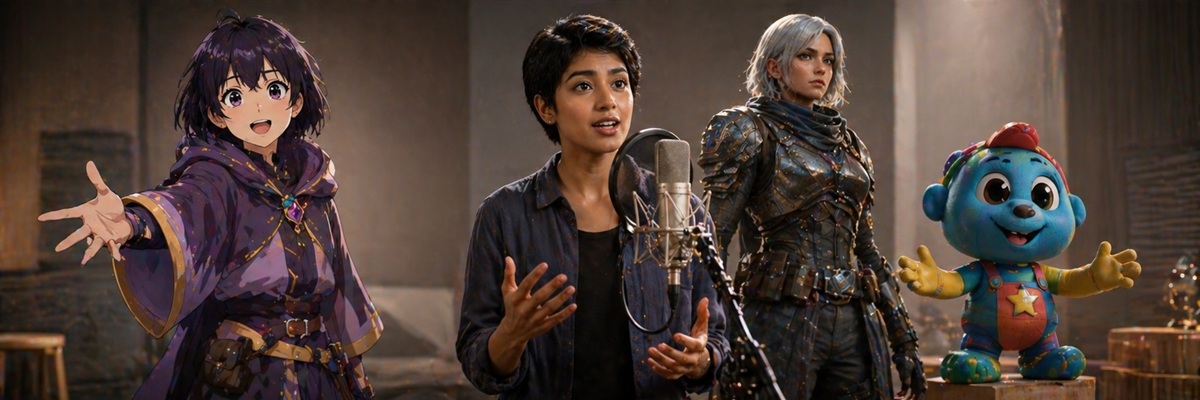
The Society of Voice Arts and Sciences (SOVAS) continues to stand as one of the most respected institutions recognizing excellence in voice acting. Each year, its awards spotlight performers across a wide range of categories, offering a detailed view of how voice work continues to evolve across industries.
This year’s character voiceover winners reflect just how expansive the field has become. From anime and video games to toys, animation, and international dubbing, the performances recognized by SOVAS demonstrate that character voice acting is no longer confined to a single format. Instead, it exists across multiple platforms, each requiring its own approach, tone, and skill set.
Looking at these winners more closely reveals not only individual achievements, but also the broader range and adaptability that define modern character voice acting.
Character Voice Acting Across Different Mediums
One of the most striking aspects of this year’s SOVAS winners is the diversity of mediums represented. Character voice acting now spans industries that operate very differently from one another, yet share a common reliance on performance.
Morgan Berry’s win for Outstanding Anime Character Voiceover Performance as Fuyumura in Sanda highlights the demands of anime work. Berry has built a strong presence in anime dubbing and original productions, known for performances that balance emotional intensity with clarity. Her background includes roles across both English dubs and original voice tracks, giving her a wide range of experience in character-driven storytelling. In Sanda, her performance reflects the expressive nature of anime while maintaining control across evolving scenes.
In contrast, Peter Wicks’ recognition for Outstanding Video Game Character Voiceover Performance as Frank Smith in Among Ashes points to a different type of performance environment. Video game acting often involves interactive storytelling, where dialogue must feel natural within gameplay rather than structured scenes. Wicks’ work reflects a grounded approach, aligning with the immersive expectations of modern game narratives. His performance supports player engagement, where consistency and realism play a larger role than stylization.
Amanda Turen’s award for Outstanding Toy Character Voiceover Performance as Cosmo in Tonies Lalalinos – Bumbaloo Beats introduces yet another format. Toy-based voice acting focuses on accessibility and engagement, particularly for younger audiences. Turen’s work emphasizes clarity, warmth, and rhythm, creating a character that connects immediately. Her background in voiceover includes children’s content and character work designed for interactive experiences, making her performance well-suited to this format.
These three winners alone demonstrate how character voice acting adapts depending on the platform. Each performance operates under different expectations, yet all fall within the same broader category.
Performance Styles That Define Each Category
Character voice acting is shaped by the requirements of each medium. While the goal is always to create a believable and engaging character, the method of achieving that goal varies significantly.
Anime performances, such as Morgan Berry’s, often lean toward heightened expression. Characters operate within stylized worlds, and the voice needs to reflect that energy. Emotional shifts can be more pronounced, and pacing may be faster to match visual storytelling. This requires strong control to avoid overperformance while still meeting the demands of the genre.
Video game performances take a different approach. In many cases, actors record dialogue that will be experienced in a non-linear way. Scenes may be triggered by player actions, and dialogue needs to feel natural regardless of context. Peter Wicks’ performance reflects this balance, maintaining consistency while allowing the character to exist within a flexible narrative structure.
Toy and children’s content introduces another layer. Amanda Turen’s work as Cosmo focuses on immediate connection. The performance needs to be clear, engaging, and easy to follow. There is less emphasis on subtle variation and more focus on creating a recognizable tone that audiences can quickly associate with the character.
These variations highlight an important point. Character voice acting is not defined by a single style. It is shaped by the environment in which the performance exists, requiring actors to adjust their approach while maintaining a strong sense of identity.
Character Identity Across Languages and Regions
This year’s SOVAS winners also reflect the global nature of character voice acting. Several awards recognize performances outside of English-language productions, emphasizing the importance of localization and international storytelling.
Simisola Gbadamosi’s recognition in the Outstanding Animation Character category for Best African Voiceover Performance as Tola Martins points to the growing visibility of regional voice acting industries. Her work contributes to a broader representation of voices in animation, bringing cultural authenticity to the performance. Gbadamosi’s background includes both on-screen acting and voice work, allowing her to bring a nuanced approach to character creation.
In Portuguese-language performance, Audrei Hüllen’s work in Pipas demonstrates how character voice acting translates across languages. Performances like these require not only acting ability, but also an understanding of how tone and rhythm function within a specific language.
Spanish-language categories further expand this perspective. Vero Lopez Trevino’s award for her dubbing performance as Paula Persimmon in Dreams Productions highlights the precision required in adapting characters for different audiences. Dubbing requires alignment with original performances while maintaining natural delivery in the target language.
Natalia Rosminati’s work as Plim Plim in Plim Plim reflects a different aspect of Spanish-language voice acting, focusing on character identity in original productions rather than adaptation. Her performance emphasizes clarity and consistency, particularly important in content aimed at younger viewers.
These international winners show that character voice acting is not limited to one region or style. It exists across languages, each with its own expectations and performance techniques.
Building Character Through Voice Alone
At the core of all these performances is the ability to create a character using voice as the primary tool. Regardless of format, the actor must establish identity, tone, and emotional range without relying on physical presence.
This process begins with defining the character’s voice. Tone, pacing, and rhythm all contribute to how the character is perceived. The voice needs to feel consistent, allowing audiences to recognize the character immediately.
Sustaining that identity over time is equally important. Many of these performances extend across multiple episodes, scenes, or interactions. The voice must remain stable while adapting to changes in the story.
Actors like Morgan Berry and Natalia Rosminati demonstrate this consistency in their respective roles. Their performances maintain a clear identity even as the narrative evolves, allowing audiences to stay connected to the character.
In dubbing work, performers such as Vero Lopez Trevino face an additional challenge. They must align their voice with an existing performance while still making the character feel natural within a different language. This requires precise control over timing and delivery.
Across all formats, the goal remains the same. The voice becomes the character, shaping how the audience understands and connects with the role.
Recognition Across Expanding Character Categories
The range of winners in this year’s SOVAS awards reflects how much the character voice acting category has expanded. It now includes performances across animation, games, toys, and multiple languages, each with its own standards and expectations.
This expansion highlights the growing importance of voice acting within modern entertainment. As content continues to diversify, character voice work plays a central role in defining how stories are experienced.
SOVAS recognition provides a platform for these performances, bringing attention to work that often operates behind the scenes. By covering multiple categories, the awards acknowledge that character voice acting is not a single discipline, but a collection of specialized approaches.
The inclusion of demo-based recognition, such as Gianfranco Mastrorosa’s award for Outstanding Animation Character Demo in Spanish Voiceover, also points to the importance of preparation and presentation in the field. Even outside of full productions, the ability to create a compelling character voice remains a key skill.
The performances recognized this year show that character voice acting continues to evolve alongside the industries it supports. Actors are working across formats, adapting to different audiences, and bringing characters to life in ways that reflect both technical skill and creative interpretation.
SOVAS winners provide a snapshot of this evolution. They highlight not only individual achievements, but also the broader range of work that defines character voice acting today.
As the field continues to expand, the ability to move between styles, languages, and platforms will remain central to success. The voices recognized here represent that adaptability, shaping characters that reach audiences in different ways across the world.