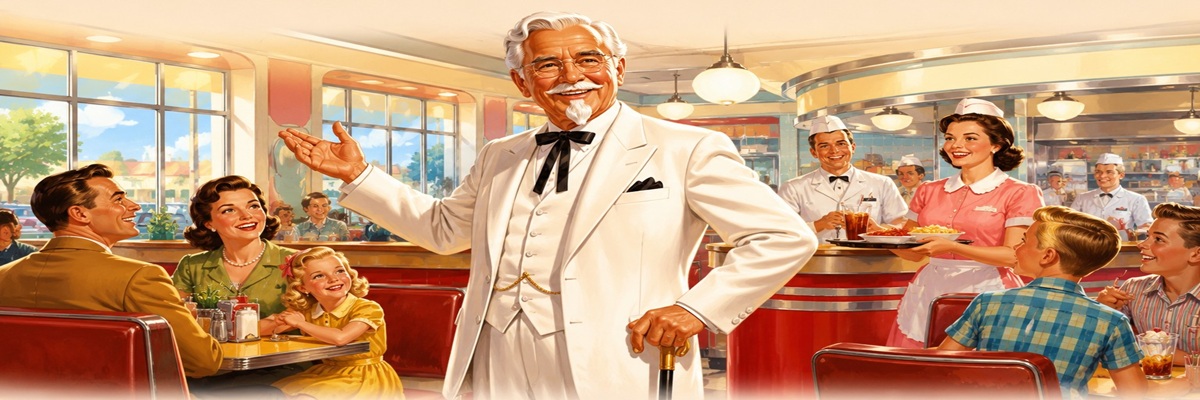
Commercial voiceover is often associated with narration. Audiences hear a confident announcer describe a product, explain an offer, or establish a brand identity through a distinctive vocal style. Yet some of the most memorable commercial performances in advertising history were never built around narration at all. Instead, they were built around characters.
Advertising has long relied on mascots, spokespersons, and fictional personalities to create emotional connections with consumers, but very few commercial characters have demonstrated the longevity, flexibility, and cultural staying power of Colonel Sanders. What began as the public persona of Kentucky Fried Chicken founder Harland Sanders eventually evolved into one of the most recognizable recurring performance roles in modern advertising.
The Colonel campaign is particularly fascinating because it occupies a unique space between branding, acting, and commercial storytelling. Over several decades, the character transformed from a real entrepreneur appearing in television advertisements into a role portrayed by comedians, actors, television personalities, and entertainers across multiple generations. The modern version of the campaign eventually earned recognition from advertising and public relations organizations while helping restore KFC’s cultural relevance in an increasingly competitive restaurant market.
For voice actors, commercial performers, and advertising professionals, the Colonel Sanders campaign offers a valuable case study in how character performance can become the driving force behind an award-winning commercial strategy.
From Founder to Advertising Legend
Unlike many advertising mascots, Colonel Sanders did not begin as a fictional creation. Harland Sanders was a real person whose image became inseparable from the company he founded. Throughout the early growth of Kentucky Fried Chicken, Sanders personally appeared in marketing materials, promotional events, and television commercials. His distinctive white suit, black string tie, glasses, and Southern gentleman persona helped establish a visual and emotional identity that customers immediately associated with the brand.
These early appearances worked because audiences perceived them as authentic. Sanders was not an actor portraying a restaurant founder. He was the founder. His mannerisms, speech patterns, and personal story became part of the company’s public identity. At a time when many brands relied heavily on announcers and traditional advertising language, KFC benefited from having a real personality at the center of its messaging.
From a performance perspective, authenticity became the character’s greatest strength. Sanders projected confidence, warmth, and experience without appearing overly polished. Customers felt they were hearing directly from someone who genuinely cared about the product being sold. That emotional connection helped establish trust, and trust remains one of the most valuable assets any commercial campaign can possess.
As the years passed and Sanders became more of a historical figure than an active spokesperson, the challenge for KFC became preserving that emotional connection while adapting the character for new audiences. Many brands would have retired the persona entirely. Instead, KFC eventually found a way to transform Colonel Sanders into something much larger than a founder.
The Colonel became a character capable of surviving beyond the individual who originally inspired him.
The Award-Winning Revival That Reintroduced Colonel Sanders
By the early 2010s, KFC faced a branding challenge familiar to many long-established restaurant chains. Competition had intensified, consumer habits were changing, and younger audiences often viewed the company as less culturally relevant than many of its competitors. The brand still possessed strong recognition, but recognition alone was not enough to generate excitement.
In 2015, KFC launched a major effort to revive Colonel Sanders as a central figure within its advertising. Rather than presenting the character as a historical symbol, the company made him the star of an ongoing series of television commercials that blended nostalgia, humor, and self-awareness.
The revival quickly attracted attention because it embraced comedy instead of strict historical accuracy. The campaign acknowledged the absurdity of repeatedly bringing back a founder who had been gone for decades, and audiences responded positively to the approach. Rather than treating the Colonel as a sacred corporate figure, KFC treated him as an evolving entertainment property.
The strategy proved remarkably successful. Industry observers frequently pointed to the campaign as a major factor in KFC’s renewed cultural visibility. The effort earned recognition through the Effie Awards, which celebrate marketing effectiveness rather than creative execution alone. The campaign also received praise across advertising circles and contributed to broader recognition that eventually included honors such as induction into the PR News Platinum Hall of Fame.
What made these achievements particularly notable was that the campaign’s success depended heavily on performance. The commercials worked because audiences enjoyed watching different interpretations of the character. Advertising effectiveness, cultural relevance, and commercial performance became closely intertwined.
The Colonel was no longer simply a logo or mascot. He became an ongoing role.
Multiple Actors, One Character
One of the most unusual aspects of the Colonel revival was KFC’s decision to embrace constant recasting. Most advertising campaigns seek consistency by using the same spokesperson year after year. KFC moved in the opposite direction.
The first major relaunch featured comedian and former Saturday Night Live performer Darrell Hammond. Hammond’s version established the comedic foundation that would define much of the campaign’s future direction. Instead of attempting a perfect imitation of Harland Sanders, Hammond created a performance that balanced familiarity with humor.
Once audiences accepted the idea of a modern Colonel, KFC began experimenting aggressively.
Norm Macdonald brought his signature dry delivery to the role. Jim Gaffigan leaned into self-deprecating comedy. George Hamilton famously portrayed an exaggerated sun-tanned version of the Colonel. Rob Lowe appeared in multiple variations, including an astronaut Colonel and a holiday-themed interpretation. Billy Zane, Rob Riggle, Sean Astin, Jason Alexander, and others each contributed their own distinct take on the character.
The campaign also expanded beyond traditional casting expectations. Reba McEntire became the first woman to portray the Colonel in a national campaign, while Mario Lopez later appeared in a holiday-themed version of the character. Each casting decision generated media coverage because audiences began anticipating the next reinterpretation.
This approach succeeded because KFC maintained a strong character foundation while allowing performers creative freedom. Certain visual elements remained consistent, including the white suit and recognizable silhouette, but individual actors were encouraged to bring their own comedic sensibilities and performance styles to the role.
From a commercial-performance standpoint, that balance was crucial. The audience always recognized the Colonel, yet every new campaign felt fresh.
When Commercial Acting Becomes the Marketing Strategy
Most advertising campaigns use performance to support the marketing message. KFC’s Colonel revival often reversed that relationship. The performance itself became the attraction.
Viewers did not simply watch the commercials to learn about menu items or promotions. Many tuned in specifically to see which actor would appear next and how that performer would reinterpret the role. The campaign effectively transformed casting announcements into marketing events.
That strategy reflected a growing trend within advertising where audiences increasingly respond to entertainment value rather than direct promotional messaging. Commercials compete not only with other advertisements but also with streaming services, social media, gaming, and countless other forms of content. Successful campaigns frequently function as entertainment first and advertising second.
KFC understood this shift exceptionally well. By treating the Colonel as an evolving performance role, the company created a format capable of generating ongoing conversation. Every new actor brought fresh media attention, while the core character remained recognizable enough to preserve brand continuity.
The industry’s response reinforced the campaign’s significance. Beyond formal awards and honors, marketing professionals frequently cited the Colonel revival as an example of successful brand reinvention. The campaign demonstrated that a legacy character could remain relevant without abandoning the qualities that made the original figure memorable.
The success also influenced broader discussions about commercial character performance. Brands such as Progressive with Flo, GEICO with its recurring cast of characters, and Jack in the Box with its long-running mascot all benefited from the understanding that strong character work can become a central component of advertising effectiveness.
Commercial Character Performance as an Art Form
Commercial voiceover and commercial acting are often discussed separately, but campaigns like Colonel Sanders demonstrate how closely connected those disciplines can be. Every actor who portrayed the Colonel faced the same challenge: maintain enough familiarity for audiences to recognize the character while introducing enough individuality to justify a new interpretation.
That requires many of the same skills associated with traditional character acting. Timing, vocal delivery, physical performance, personality development, and audience awareness all play essential roles. Unlike a typical commercial narrator, the performer is not simply communicating information. The performer is sustaining an ongoing fictional identity.
The Colonel campaign also highlights how character consistency can survive across multiple actors. Audiences accepted dramatically different interpretations because the core traits remained intact. Humor, confidence, friendliness, and a degree of self-awareness continued to define the character regardless of who happened to be wearing the white suit.
Perhaps most importantly, the campaign demonstrated that commercial performance can achieve recognition beyond advertising itself. Awards, industry honors, and long-term business success all reflected the effectiveness of the strategy, but those achievements ultimately depended on the performers who brought the character to life.
The enduring appeal of Colonel Sanders shows that some of advertising’s most memorable work emerges when brands treat performance as more than a supporting element. When executed successfully, character acting can become the marketing strategy, the entertainment, and the emotional connection all at the same time. The Colonel remains one of the clearest examples of how a commercial character can evolve across generations while continuing to captivate audiences and influence the broader advertising industry.
